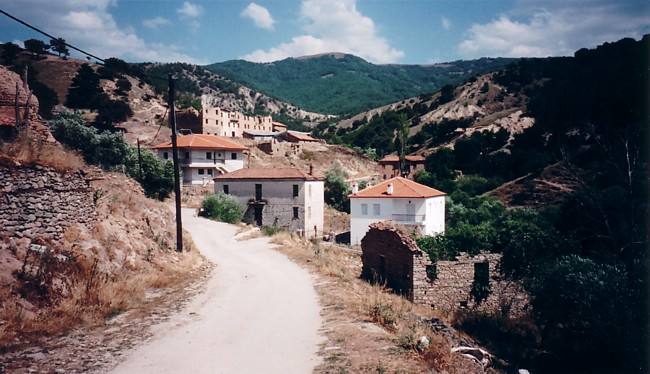
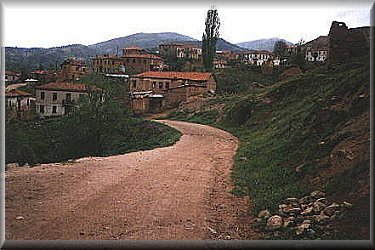

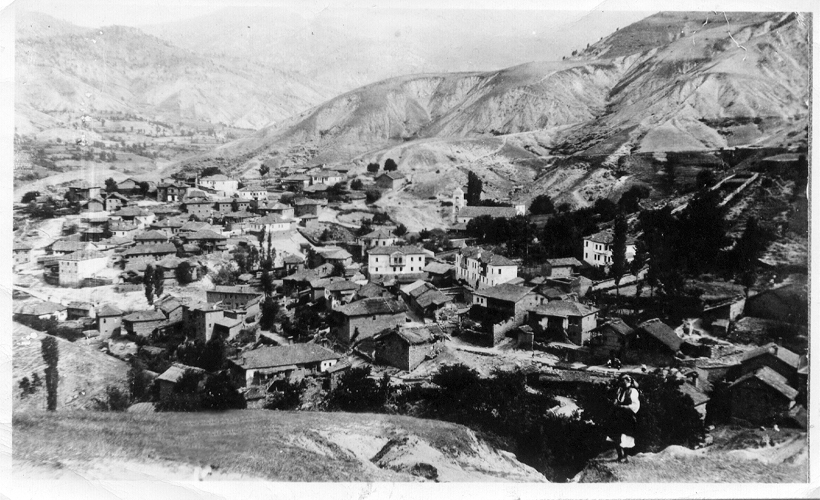
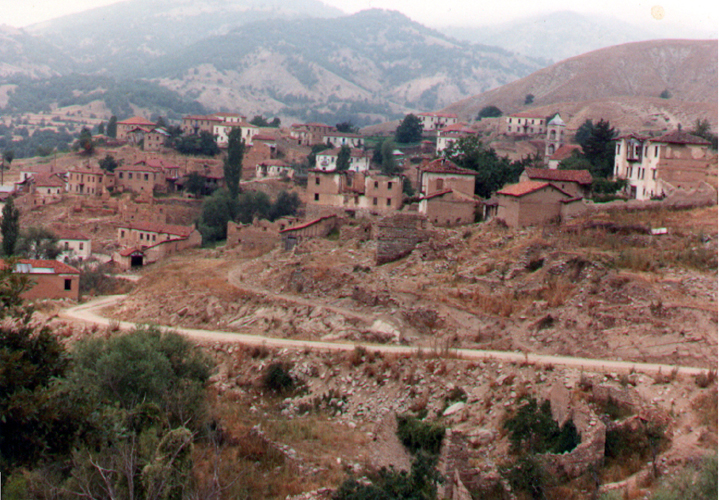
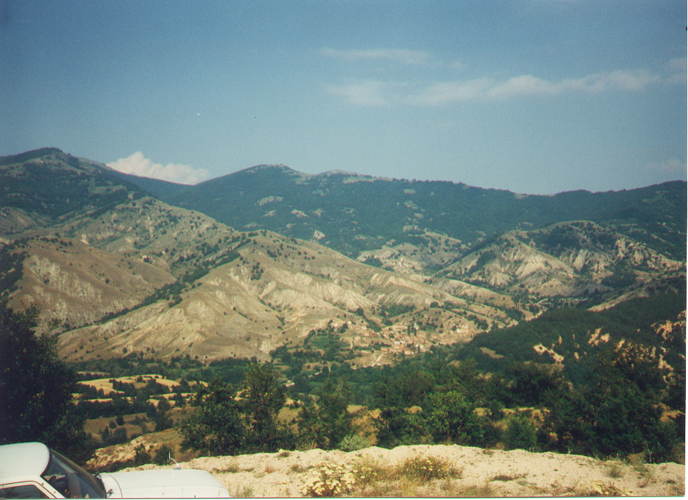
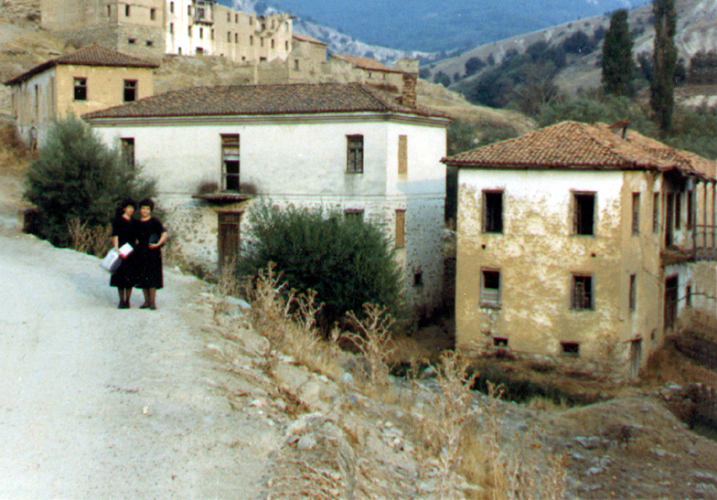
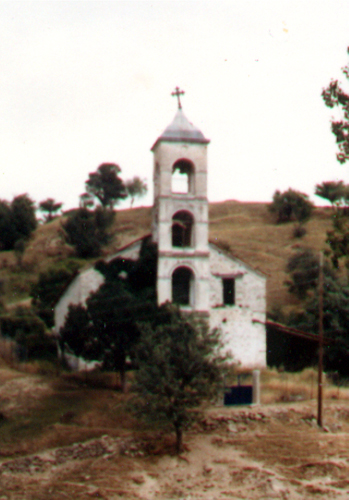
The village of Oshchima is situated in Southern Macedonia, midway between the cities of Lerin to the north and Kostur to the south. It lies near the head of the Bistritsa River (clear white), amid a beautiful green valley, and is embraced on three sides by the majestic mountains; namely, on the north the towering Bigla, on the east the Gomnosh, on the west the twin peaks of Lokma and Bodanitsa.
Completing this picturesque setting are the friendly neighbouring villages : Zhelevo and Pisodery to the north, Tersia and Statitsa nearby to the east, Besfina and Prespa District to the west, and Turnava and Rula to the south.
A pretty picture? Yes. But to us Oshchima is more than a pretty picture. It was our home; the home of our people; a people who are typical of Macedonia, proud of their heritage and history, which dates back to the days of Alexander the Great. They are hard working, highly ethical, and progressive people. They have a deep rooted love for independence, but independence has been denied to them for over 500 years. Instead oppression and foreign occupation has been their cruel fate. They suffered at the hands of the Turkish overseers for over five centuries. Their homes and villages were often razed and pillaged. Social and political activities - the most important and essential elements in human life and society were denied to them. Schools were unknown to our people until the middle of the 20th century. They were kept in a perpetual state of ignorance and poverty.
However, neither oppression nor ignorance could defeat the magnificent will of our people to survive. Using primitive tools and home made materials, they built their own roads, water supplies, churches, schools and homes. The Turkish officialdom offered no support or guidance. Their sole concern was the tax levy which was collected by unscrupulous officials who were always harsh and brutal.
Under the rule of the Ottoman Empire, all productive farm lands were confiscated by the Turkish feudal lords (beys) without compensation to the owners. Thus deprived of their good lands, our people turned to the hills and mountains. Though the hills and the mountains were scenic and beautiful wonderlands, but were unfit for agricultural cultivation.
Men, women and even little children toiled from sunrise to sunset only to derive a bare existence from the stubborn hills.
Laboriously they tended small gardens, orchards and farm plots. They also raised cattle and sheep. The yields were small and of poor quality. The meagre surpluses could not be turned into cash through lack of transportation and local markets. Without money even the simplest domestic necessities were beyond their means. Consequently, the men often left the housework to the women and children, and sought employment in foreign countries, both near and far and were absent from the village for many months, and sometimes for years.
The First Immigrants to Canada
However, the turn of the 20th Century was a milestone in the history of our people. The year 1903 saw the great national "Ilinden" uprising. Our heroic Macedonian people though hopelessly outnumbered, fought stubbornly for their freedom and independence. The uprising was lost to the overwhelming Turkish "hordes" but not before the plight of the Macedonians gained worldwide attention and sympathy. As a result of this revolt they were able to get many concessions from the embarrassed Sultans of the Ottoman Empire. Today the anniversay of the "Ilinden" uprising is celebrated as a national holiday by all Macedonians everywhere.
Canada and the United States of America were unknown in our village until 1904. In the fall of that year the first group of five men left our village destined for Canada. They were Bojin Christo Temoff, who now rests in the private village plot at Prospect Park Cemetery, Toronto. Trayn George Jigeroff, George Naum Argiroff, Nicola S. Agriroff and Naum Poppoff. All these men were vetersans of the "Ilinden" uprising the previous year.
These first five men set a pattern for the many others who were to follow them. The main aim of our men in those days was to earn some money in the shortest possible time and return back home to their families in their old homeland, Macedonia. A few of them stayed one year, others two years at the most. All returned with their savings to the village, remodelling and improving their homes and aiding their families in their daily work. But the few dollars brought from Canada were spent all too quickly, and within a year or less they returned to Canada a second time, and then a third.
No one at that time entertained the slightest notion of settling permanently in Canada. How could they abandon the place of their birth? Their homes? Full of memories, so sweet, so beloved, and at times so sad? At first, no. But in the years of 1915 and 1916 a new trend started, the first two women from our village left for Canada to join their men. They were Sotiritsa Stamkova and Karstovitsa Gustova. And after the First World War other women followed in great numbers. And as the saying goes: "Where the women go, there goes the home." Yes, we stayed here, but we did not forget our old homeland. Each of us though loyal to our new home, Canada, carried a small piece of Macedonia in our hearts.